1/29/10

Breakthrough and Telehealth's Tipping Point

58916v2-max-250x250-1

 If you told me last year that web-base psychotherapy would gain traction I wouldn’t have believed you.  That was before I met Mark Goldenson, CEO of Breakthrough, a silicon valley based web startup that matches patient and therapist through a secure online portal.  Breakthrough clients can review a therapist’s qualifications and fees, view sample video, and initiate therapy by video or phone.

In a 2.0 world marked by clouds, hives and democratized healthcare, Breakthrough is cultivating one-on-one relationships through improved access to mental health services.  Everyone should be talking about this.

Goldenson made the TechCrunch 50 this past fall and maintained his continence before the likes of Tim O’Reilly, Kevin Rose and other tech luminaries.  You can check out the coverage in Wired and Forbes. 

The road to viable online teletherapy is littered with skeletons of those who were either ahead of the parade or didn’t have the technical support of Breakthrough.  But telehealth has reached a tipping point.  And Breakthrough may be there to seize the moment and tap the 2/3 of America’s 58 million with mental illness too stigmatized to seek help in person. 

I’d like to say I discovered Mark Goldenson but it was he who discovered me after I delivered a lunchtime keynote on social media at this year’s American Telemedicine Association meeting in Palm Springs.  He’s a pretty sharp guy.  And if the fervency of his questions is any measure of his capacity to lead, Breakthrough may be worth keeping and eye on. 

BreakThrough is continuing to move forward with its teletherapy model for matching psychiatric patients with specialists through streaming video connection. Most of the company's early successes have been the accolades lavished upon its CEO, Mark Goldenson, but little news has emerged about the Silicon Valley startup's experiences in the trenches. I would be particularly interested to hear about the company's experiences negotiating reimbursement with providers. More investigation seems to be in order, but its generally encouraging to see telehealth and telemedicine can play in Silicon Valley.

Posted via web from Connected Care Solutions

1/28/10

New Physician Adoption Statistics « Health IT Buzz

New Physician Adoption Statistics
Tuesday, January 26th, 2010 | Posted by: Dr. David Blumenthal | Category: ONC

The CDC recently released its latest report on the adoption of electronic health records/electronic medical records (EHR/EMR) amongst office-based physicians from the National Ambulatory Medical Care Survey. As a physician who trained and initially practiced in a time where nearly every order, record, and prescription was paper-based, the results are striking to me.

The final results for 2008 show about 16.7 percent of physicians reported having systems that met the criteria of a basic EHR/EMR system, and about 4.4 percent reported that of a fully functional system. Preliminary results for 2009 show about 20.5 percent reported having systems that met the criteria of a basic system, and 6.3 percent reported that of a fully functional system.

Combined basic and fully functional statistics for the last 3 years are as follows:

  • 2007 – 17%,
  • 2008 – 21%,
  • Preliminary 2009 – 27%

The latest figures, especially the preliminary 2009 numbers, suggest that the pace of adoption of HIT is quickening. We expect that the federal government’s health IT strategy will accelerate the pace even further by systematically addressing the obstacles physicians experience in adopting health IT (see below).

HOW THE US FEDERAL GOVERNMENT IS SUPPORTING HEALTH INFORMATION TECHNOLOGY USE

The Obama administration believes health information technology (HIT) is a critical component of efforts to improve the quality, efficiency, and value of care delivered to patients. The Office of the National Coordinator for Health Information Technology (ONC) is leading the administration’s efforts to support the thoughtful application of HIT. Cognizant of the numerous barriers that exist to making health IT work in real-world settings, the ONC is administering programs to systematically address these barriers:

OBSTACLE INTERVENTION FUNDS
Financial Resources Medicare and Medicaid Incentive Program: incentive payments to “meaningful users” who use health information technology to improve value and efficiency of care delivered to patients
Technical Assistance Regional Extension Centers: Up to 70 regional extension centers (REC) will help providers through the process of selecting and implementing electronic health records $643 Million

The vision of a health care system that uses information technology to improve the value of services to patients is inching closer towards reality.

The ONC is committed to making the transition to electronic health records successful for every physician and hospital.

I hope you will share the experiences, challenges, and success stories that belie these encouraging statistics.

– David Blumenthal, M.D., M.P.P. – National Coordinator for Health Information Technology

National Coordinator for Health Information Technology, David Blumenthal, MD, blogs about physician adoption of electronic health records, a subject on which he has long been the go-to authority. With merely 27% of physicians deploying a fully functional EHR, its now up to Blumenthal to find real solutions and strategies for stimulating widespread adoption. So far his ideas and initiatives have been promising.

Posted via web from Connected Care Solutions

1/27/10

Video Conferencing saving lives in Irish Hospitals

Claire O’Connell in the Irish Times has an interesting article on how a stroke patient at the Midland Regional Hospital in Mullingar received urgent and potentially life-saving treatment on Sunday after a consultant at another hospital used the RP-7 (the “Remote Presence Robot” pictured below) to assess her remotely and prescribe clot-busting medication.

“The patient, who had a stroke just after noon, was collected by ambulance and was at the Midland Regional Hospital in Mullingar by 1.30pm. She was assessed by Prof Des O’Neill at Tallaght Hospital using the RP-7, which also allowed him to talk with her, examine her scans and discuss treatment with members of the medical team in Mullingar. The patient was on clot-busting medication by 2.40pm and her condition improved in half an hour”

Prof O’Neill commented on this first with a reminder of the short time window there is for putting suitable patients on potentially life-saving thrombolytic drugs; “The key challenge is to get people to have their clot-busting drug within three hours of a stroke.”

This entry was posted on Wednesday, January 20th, 2010 at 10:42 am and is filed under Uncategorized. You can follow any responses to this entry through the RSS 2.0 feed. You can leave a response, or trackback from your own site.

Posted via web from Connected Care Solutions

Federal Telemedicine News: Grant Announcement Posted

Grant Announcement Posted

HRSA recently posted their “Small Health Care Provider Quality Improvement Grant Program” announcement seeking rural providers ready to implement quality improvement strategies. The plan is to help improve patient care and chronic disease outcomes for diabetes mellitus, and cardiovascular disease. The grant’s goal is to help rural primary care providers achieve these goals by using the Chronic Care Model along with Electronic Patient Registries (EPR).

Both the EHR and EPR are electronic systems, but the EPR captures information that is population-based with data on specific conditions. This grant program does not support funding for an EHR, but healthcare providers who currently have an EHR are still eligible to participate in the program.

Some of the previous grantees have used their experience working with EPRs as a stepping stone to electronic medical records adoption. These grantees also have interests in the medical home model to help spread and sustain their quality improvement initiatives that go beyond chronic disease tracking to disease prevention. Grantees have also developed business case models to help sustain their quality improvement initiatives.

The program will provide funding during FY 2010-2012. Approximately $6,000,000 is expected to be available annually and to fund up to 60 grantees. Applicants can request up to $100,000 per year. Funding beyond the first year is dependent on the availability of funds in subsequent fiscal years.

Applicants must be a rural public or rural non-profit private entity and must not have previously received a grant for the Rural Quality Grant Program or a similar project. Examples of eligible entities include rural health clinics, critical access hospitals, small rural hospitals, and Federally Qualified Health Centers. For profit Rural Health Centers and Critical Access Hospitals may also apply.

Eligible applicants must also meet at least one of these three requirements:

• Applicants must be located in a rural area
• Applicants exist exclusively to provide services to migrant and seasonal farm workers in rural areas
• Applicant is a Tribal government where grant funded activities will be conducted within their Federally recognized Tribal area

The application is due March 15, 2010. For more information, go to http://www.grants.gov/ or contact Elizabeth Rezaizadeh, Program Coordinator by email at erezai@hrsa.gov or call (301) 443-410.

Posted via web from Connected Care Solutions

Personal Health Systems: A View from Across the Pond | Chillmark Research

The European Union (EU) is struggling with many of the same healthcare issues as the US, aging population, ever increasing costs of care and the need to move to new modalities of care.  This is one of the key take-aways from a recent EU-sponsored report: Reconstructing the Whole: Present and Future of Personal Health Systems.  This report looks at the present state of Personal Health Systems (PHS), assesses gaps (technology, process & culture) and lays out what is required to meet the “promise of PHS” by the year 2020.

The report takes a very broad brush to what is PHS including IT, sensors, diagnostics, and drug development (personalized).  This is a big report at some 240pgs and unfortunately is one of those reports that is all too big and all too academic to be useful to the average healthcare wonk.  But tucked within this future, sitting-on-the-bookshelf and collecting dust report are a couple of tidbits worth mentioning.

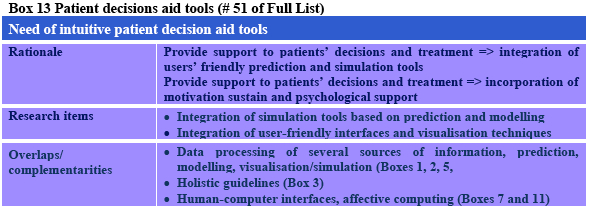
On pages 79-86 are a series of gap analysis tables (20 in all) addressing a wide range of areas associated with PHS.  Below is the Table addressing Patient Decision Aid Tools.

While the above gap analysis tables are instructive, they are not terribly “deep” and at times come across as superficial – thus would make good fodder for a “high-level” presentation to a less informed audience.

Arguably the best Table is found towards the end of the report titled: Six Domains of Implementation Gaps.

The table clearly lays out what are the future challenges to broader adoption and use of PHS.  The key take-away here is the surprising similarity between the US and its EU counterparts in the deployment and use of PHS, despite what are very different healthcare system models.  Which raises the question: Will such uber-players in the Personal Health Platforms (PHP) market, e.g., Dossia, Google Health and HealthVault create the systems and platforms required to support PHS data requirements?  HealthVault’s move into international markets, (Canada and Thailand) signal yes, but will providers, payers and ultimately consumers join in?

Still more questions then answers at this early juncture in the development of consumer-focused systems and platforms.  But there is a ray of hope in the global commonality of challenges faced that will lead to increasing attention and subsequently resources dedicated to bridging the gaps, addressing these challenges to create more effective and efficient care delivery models.

Chillmark Research does some very nice digging for useful learnings to be gleaned from an EU-sponsored report on the present and future of personal health systems. The second chart in particular does a great job of outlining the barriers to the establishment of a wholly unified personal health system.

Posted via web from Connected Care Solutions

Federal Telemedicine News: MHS IM/IT Plan Approved

MHS IM/IT Plan Approved

The Military Health System Information Management/Information Technology Strategic Plan for 2010-2015 has been approved by the Senior Military Medical Advisory Committee. Leaders from the Army, Navy, Air Force, Health Affairs, TRICARE Management Activity, Joint Staff, Joint Task Force National Capital Region Medical, and the MHS Office of the Chief Information gathered last summer for a series of workshops to develop the plan.

While there have been strategic planning initiatives that have guided key priorities throughout the last ten years, this new effort by IM/IT leadership across the services, is the first formally approved plan since 1999.

The plan’s ten IM/IT goals that the Military Health Service (MHS) will focus on over the next five years are to:

• Provide rapid, affordable, secure delivery, and life cycle support for IT products and services
• Provide a comprehensive longitudinal EHR for all beneficiaries and care settings
• Implement a governance structure and process to enable effective and efficient use of resources
• Enhance enterprise intelligence through the use of enterprise tools, data, and services
• Advance the MHS personalized health agenda so that patients would have electronic access to their own records, have virtual visits, and be able to refill prescriptions online
• Advance IT interoperability using health, operational, and functional partners to create an accessible and complete virtual lifetime electronic record
• Show how the flow of funds from programming to execution can improve using better cost estimating methodologies
• Establish an innovation lifecycle management process to align IT innovation with MHS strategy
• Improve human capital management by having the right people with the right training and experience on the right job
• Develop processes, guidance, and standards to develop and integrate distributed services and applications so that time and money spent on products can be delivered rapidly and with a minimum amount of modification

In total, the planning team drafted 13 unique action plans and 14 performance measurements to define specific activities, deliverables, and milestones. In the months ahead, the IM/IIT strategic planning team will work with the action plan teams across the MHS and then draft updates, review the IM/IT measures, and determine if and how these measures should link to the broader MHS Value Measures dashboard.

For more information, go to www.health.mil/mhscio/governance.htm.

This would be a great action plan for innovating/improving any health system, from the military to local and regional providers. Hopefully this crosses the president's desk and he adopts some of the major action items to his own health reform agenda. These are the major things that need to be addressed which will have the greatest impact on the health care industry.

Posted via web from Connected Care Solutions

1/23/10

Privacy & Security of Personal Health Information | Chillmark Research

On Saturday, Jan. 10th, I’ll be moderating a panel at the Consumer Electronics Show’s (CES) Digital Health Summit. The distinguished panel that includes executives from Dossia, Kaiser-Permenante, Microsoft and Walgreens will address the topic: Who Will you Trust with Your Health Data?

In preparation, I have been doing some research on the subject and following are a few data points for consideration:

Since April 2003, HHS’s Enforcement Office has handled over 9,666 cases that required some form of enforcement/corrective action regarding HIPAA privacy and security violations of Personal Health Information (PHI). That works out to over 1,200 cases a year.

In 2009, PrivacyRights.org reports that there were 46 breaches of PHI representing nearly 80M records.  Note that 76M of those records were from the VA that inadvertently sent one of its RAID drives out for repair without cleansing it of those 76M records of veterans.  If you can’t trust the government to keep your PHI safe, who can you trust?

Subtract the VA outlier and you get about 4M individuals who had their PHI breached in 2009 across 45 documented incidents or about 89,000/breach.  That’s a lot of compromised records!

Also in May of 2009 we saw the Virginia Health Data, Dept of Health Professionals get hacked in which 531,000 individuals PHI were compromised and held ransom by the hackers for a cool $10M.

And let us not forget CVS who was fined $2.25M for sloppy disposal of prescription records.  No one has any idea as to how many individuals may have been compromised in this blunder by a major pharmacy chain.

The scary thing about the above is that these numbers represent documented/reported cases of data breaches and it would be easy to argue that the actual number of breaches that occur in a given year is quite a bit higher (let’s remove the 76M records in the VA breach as that really is out there).

This all raises the question:

If organizations like the VA, the Virginia Health Data, Dept. of Health Professionals and some of the most prestigious hospitals in the country can’t keep PHI safe, who can?

Which logically leads to the next question…

Is there any true, fool-proof way to insure absolute privacy and security of PHI that is held by a covered entity, business associate or even an organization like Microsoft or Dossia acting on behalf of the consumer?

Yes, there are strong passwords, yes, data can be encrypted on a server but for just about every barrier thrown up, hackers have found a way to break in.  Also, beyond just hackers, what is surprising is that a number of the PHI breaches in 2009 were done by employees who were then selling such data to others, such as ambulance chasing lawyers and tabloid magazines.

Which leads me to conclude…

Maybe the belief in absolute privacy and security of PHI is a fallacy.

As we move to digitize PHI through the adoption and use of EHRs by physicians and hospitals it is inevitable that we will see more breaches.  Hopefully, the benefits that we, as a nation and citizens, accrue from the adoption and use of such digital records to better manage our health and coordinate health among our healthcare team will far outweigh the risks we will be taking in the potential compromise of our PHI.

Possibly related posts: (automatically generated)

Posted via web from Connected Care Solutions

1/18/10

Healthcare IT Consultant Blog: Up to $43.2M to GE Healthcare for US Military Patient Monitoring Systems

Sunday, January 17, 2010

Up to $43.2M to GE Healthcare for US Military Patient Monitoring Systems


GE Healthcare in Wauwatosa, WI won a maximum $43.2 million fixed price with economic price adjustment contract to supply patient monitoring systems to the US military as well as federal civilian agencies.
GE Healthcare received its 1st contracts to supply patient monitoring systems to the US military in March 2009, after 2 years of negotiations between the company and the US Defense Supply Center Philadelphia. GE received two 10-year contracts (1 year base with 9 one-year options), worth a maximum of $63 million annually, to supply patient monitoring systems as well as supporting communications equipment and IT systems…

Under the March 2009 contracts, GE Healthcare is also supplying diagnostic cardiology devices and cardiology information archival systems; catheterization laboratory monitoring; Datex-Ohmeda anesthesia delivery, infant incubators and warmers; and fetal monitoring, perinatal information systems, and blood pressure cuffs to the US military and US federal agencies.
For the $43.2 million contract, the date of performance completion is Jan 13/11. There were originally 17 proposals solicited with 9 responses received by the Defense Supply Center Philadelphia, PA (SPM2D1-09-D-8300).

GE Healthcare locks up remote patient monitoring contract with the DoD for $43.2mm, but this is merely the tip of the iceberg in Federal Health IT-related opportunities.

Posted via web from Connected Care Solutions

1/1/10

Billionaire Doctor Puts His Money Where His Mind Is...


Patrick Soon-Shiong elaborates in this CNBC feature on his ambitious vision and $1Billion philanthropic commitment to build a true naitonal Public HealthGrid.

Boldly, and brilliantly IMHO, Soon-Shiong asserts that we need to stop obsessing over advances in genomic, biotech and nanotech R&D and recognize that health systems, technology parks and even most academic research labs are ill-equipt to discover anything "meaningful" from this deluge of random data. It will be "mathematicians, physicists and computer scientists" that Dr Soon-Shiong believes hold the key to unlocking the greatest potential value for patients, physicians, regional providers, public health agencies and society at large.

The politician inside me hears Dr Soon-Shiong's vision to be a blueprint for sowing the seeds of a hyper-modern renaissance movement in America. By using "team science" to engage the greatest minds from every scientific discipline in one unified pursuit of a wickedly complex problem, Patrick may have unwittingly stumbled onto the secret formula for reshaping the very fabric of society!!
Reblog this post [with Zemanta]

Public Health Informatics Institute | phConnect.org

phConnect is a web-based, interactive, collaboration platform created for public health professionals and those interested in public health to meet, share expertise, and work together on advancing public health. phConnect has been created to foster collaboration and communication across PHIN CoPs, the larger public health community, the health informatics community, and with other partners.

Posted via web from Connected Care Solutions