Showing posts with label health care IT. Show all posts

1/27/10

Personal Health Systems: A View from Across the Pond | Chillmark Research

The European Union (EU) is struggling with many of the same healthcare issues as the US, aging population, ever increasing costs of care and the need to move to new modalities of care.  This is one of the key take-aways from a recent EU-sponsored report: Reconstructing the Whole: Present and Future of Personal Health Systems.  This report looks at the present state of Personal Health Systems (PHS), assesses gaps (technology, process & culture) and lays out what is required to meet the “promise of PHS” by the year 2020.

The report takes a very broad brush to what is PHS including IT, sensors, diagnostics, and drug development (personalized).  This is a big report at some 240pgs and unfortunately is one of those reports that is all too big and all too academic to be useful to the average healthcare wonk.  But tucked within this future, sitting-on-the-bookshelf and collecting dust report are a couple of tidbits worth mentioning.

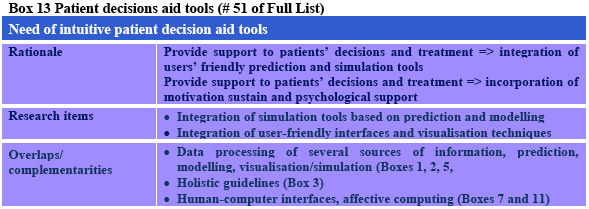
On pages 79-86 are a series of gap analysis tables (20 in all) addressing a wide range of areas associated with PHS.  Below is the Table addressing Patient Decision Aid Tools.

While the above gap analysis tables are instructive, they are not terribly “deep” and at times come across as superficial – thus would make good fodder for a “high-level” presentation to a less informed audience.

Arguably the best Table is found towards the end of the report titled: Six Domains of Implementation Gaps.

The table clearly lays out what are the future challenges to broader adoption and use of PHS.  The key take-away here is the surprising similarity between the US and its EU counterparts in the deployment and use of PHS, despite what are very different healthcare system models.  Which raises the question: Will such uber-players in the Personal Health Platforms (PHP) market, e.g., Dossia, Google Health and HealthVault create the systems and platforms required to support PHS data requirements?  HealthVault’s move into international markets, (Canada and Thailand) signal yes, but will providers, payers and ultimately consumers join in?

Still more questions then answers at this early juncture in the development of consumer-focused systems and platforms.  But there is a ray of hope in the global commonality of challenges faced that will lead to increasing attention and subsequently resources dedicated to bridging the gaps, addressing these challenges to create more effective and efficient care delivery models.

Chillmark Research does some very nice digging for useful learnings to be gleaned from an EU-sponsored report on the present and future of personal health systems. The second chart in particular does a great job of outlining the barriers to the establishment of a wholly unified personal health system.

Posted via web from Connected Care Solutions

12/10/09

California hospital's implementation of open-source EHR bears watching | EHR Watch

By the end of the year, Kern Medical Center, a county-owned 222-bed acute-care teaching hospital in Bakersfield, Calif., will have implemented Medsphere Systems’ OpenVista electronic health record (EHR). This deployment bears watching because it may become a trend in terms of providers adopting an open-source EHR.


For one, 2011 is the first year that providers can qualify for bonuses, or increased Medicare reimbursements, under ARRA. That’s shy of a year away from now. I think it’s virtually impossible to implement an EHR and derive meaningful use from it all within a year if you go the traditional, multi-million dollar, multi-year route. But KMC pointed out that the reason it chose OpenVista, which is the commercial version of the Dept. of Veterans Affairs’ VistA EHR, is for its ability to go live rapidly and its lower cost of implementation and maintenance.


In these tough economic times healthcare systems need to do more with less. KMC provides care for more than 16,000 inpatients annually, while its clinics provide care and services for more than 100,000 patients. Its emergency department handles some 43,000 visits per year. The data may be old (fiscal year 2001-2002), but they’re still relevant, especially for healthcare systems like KMC. Over the past three fiscal years prior to 2001-2002, the average daily patient census has increased. With nearly 75 percent of its patients either indigent or on Medi-Cal, KMC has to find ways to become more cost efficient in its delivery of care. On top of that, as a healthcare provider to county inmates and juvenile detainees the hospital system must also meet legal requirements for inmate and juvenile medical care. The KMC folks are banking on an open-source EHR to improve clinical outcomes in a cost-efficient manner.


What you’ll likely see in 2010 are resource-strapped healthcare systems that nonetheless believe in the clinical and financial benefits of health IT. The ARRA bonuses serve as an incentive to implement EHRs. The short timeline for qualification, however, is what will drive healthcare systems to choose EHRs that have a quick, inexpensive implementation.


The next step is achieving meaningful use. Stay tuned.

Open source systems are gaining acceptance in early phases of EHR adoption. Medicare reimbursement rates and whether choice of open source positively or negatively affects reimbursement policy will be the determinant of open source EHRs ultimate success/failure when 'meaningful use' guidelines are finally released in the coming months. Stay tuned...

Posted via web from Connected Care Solutions